Opallite asks every artist to sign a pledge against AI-generated art, then proposes an AI system to protect them. That looks like a contradiction. I wrote the plan, so I should say why I do not think it is one, and where I am still unsure.
The pledge
The No AI Pledge sits in Chapter 1 of my business plan and has five commitments. The first is blunt: the platform "will never display, sell, or promote AI-generated artwork." The other four are verification (portfolio reviews, process documentation, community validation), advocacy for artists' rights beyond the platform, transparency about tools, and educating buyers about why human-made art matters.
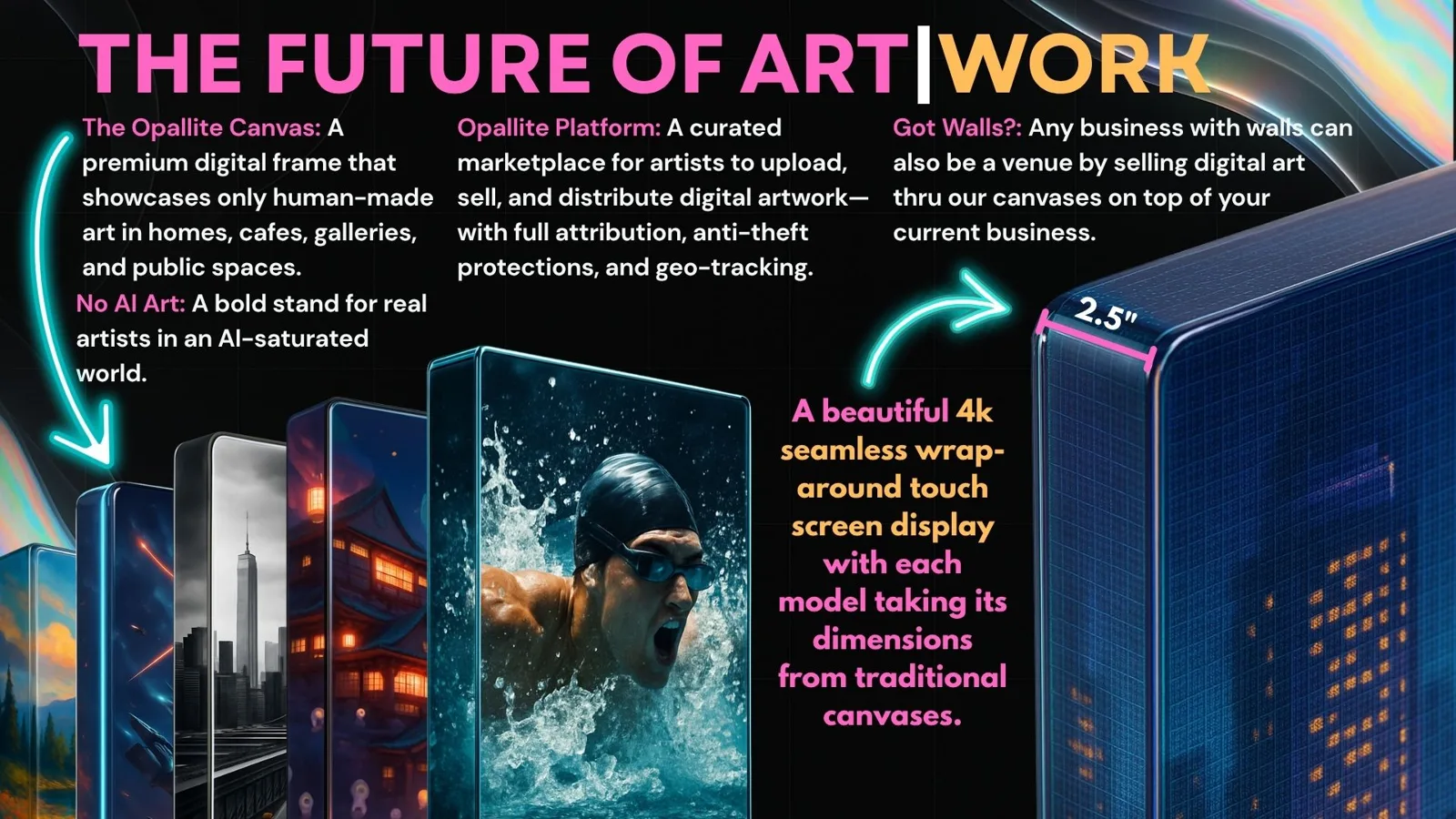
In the Deep Dive I put the problem in the artist's chair: "Imagine being a modern digital artist: Anyone can generate art that is equivalent or superior to you instantly and it might even be in your style." In that world, a wall that shows only human work is worth something. Slide 3 of the deck makes it a pillar: "No AI Art: A bold stand for real artists in an AI-saturated world."
Where the line is
Digital artists use software, and some of it now contains AI, so a flat ban would be unworkable and unfair. The pledge's fourth commitment separates two uses: AI as "a creative assistant," where the human keeps creative control and direction, and AI as "a content generator," where the AI produces the final artwork with minimal human input. The plan's summary is that the pledge "is not anti-technology but pro-human creativity."
That is a principle, not yet a test. Where an assistant becomes a generator is a judgment call, and the plan does not give a rule for it.
FAIRE
Theft is the other half. One artist cannot search the whole internet for copies of their work. The plan answers with a central registry (a fingerprint for each artwork, a timestamp of first registration) and an engine called FAIRE, pronounced "fire." The name is the idea: "fighting fire with fire—using AI strategically to defend against the very technologies that can threaten artists' livelihoods."
On paper FAIRE does five things:
- Adaptive detection that keeps pace with new ways of copying art.
- Cross-platform monitoring by image recognition across the web, social media, marketplaces and physical locations.
- Pattern recognition to spot repeat offenders and organised infringement.
- Predictive protection, closing weak spots before they are exploited.
- Enforcement automation, drafting takedown notices and cease-and-desist letters.
Protection comes in three tiers: basic verification for every account, an enhanced tier with wider monitoring, and a premium tier with legal representation. The community chapter adds the rule I care about most: "Final decisions always made by human staff rather than automated systems."
Attribution, anti-theft, geo-tracking
Three jobs sit under that one name. Attribution gives every registered work a provenance record, so "who made this, and first?" has an answer. Anti-theft means matching that survives edits and crops, metadata tracking, and watching print-on-demand sites, which the plan names as a special concern.
Geo-tracking is the one to handle carefully. The artist dashboard includes a Global Display Map showing where a work is hanging, and the plan's buyer analytics include geographic and demographic detail. Location data is sensitive. The plan describes what it collects far more than what it promises to protect, and that is a gap I own.
Three places the story is untidy
First, the pledge forbids AI-generated art, yet FAIRE is an AI system built on the same kind of pattern recognition. My answer is direction of use: it protects people and creates nothing. I think that difference is real, and I still have to keep earning it.
Second, my revenue chart scripts list "AI-Assisted" and "Generative Art" among the categories I used to size the market, and apply a capture share to each. They should come out so the model matches the promise.
Third, the plan writes FAIRE in the present tense, as if it exists. It does not. Opallite is at concept stage, with no revenue, no shipped hardware and no built FAIRE. Everything above is design.
What the pledge costs
A pledge that costs nothing is marketing. This one limits who can sell on the platform and commits me to build and run an enforcement system. I would rather say so than hide it.
