A frame is the dullest object on a wall. You put something in, hang it, and that is the end of it. In Chapter 11 of my plan I asked what changes if the frame is a swappable part and the canvas has a port for things to plug into.
The magnet
The plan describes a magnetic latch so frames attach without tools. This is my own draft spec: 80 mm between magnet points, 5 kg of pull at each point, a frame weight limit of 2 kg, 2 mm of edge clearance and an operating range of 0 to 40 C. None of it has been built or tested.
The magnet is not only about convenience. A latch with a published shape means someone other than me can make a frame that fits.

The ports
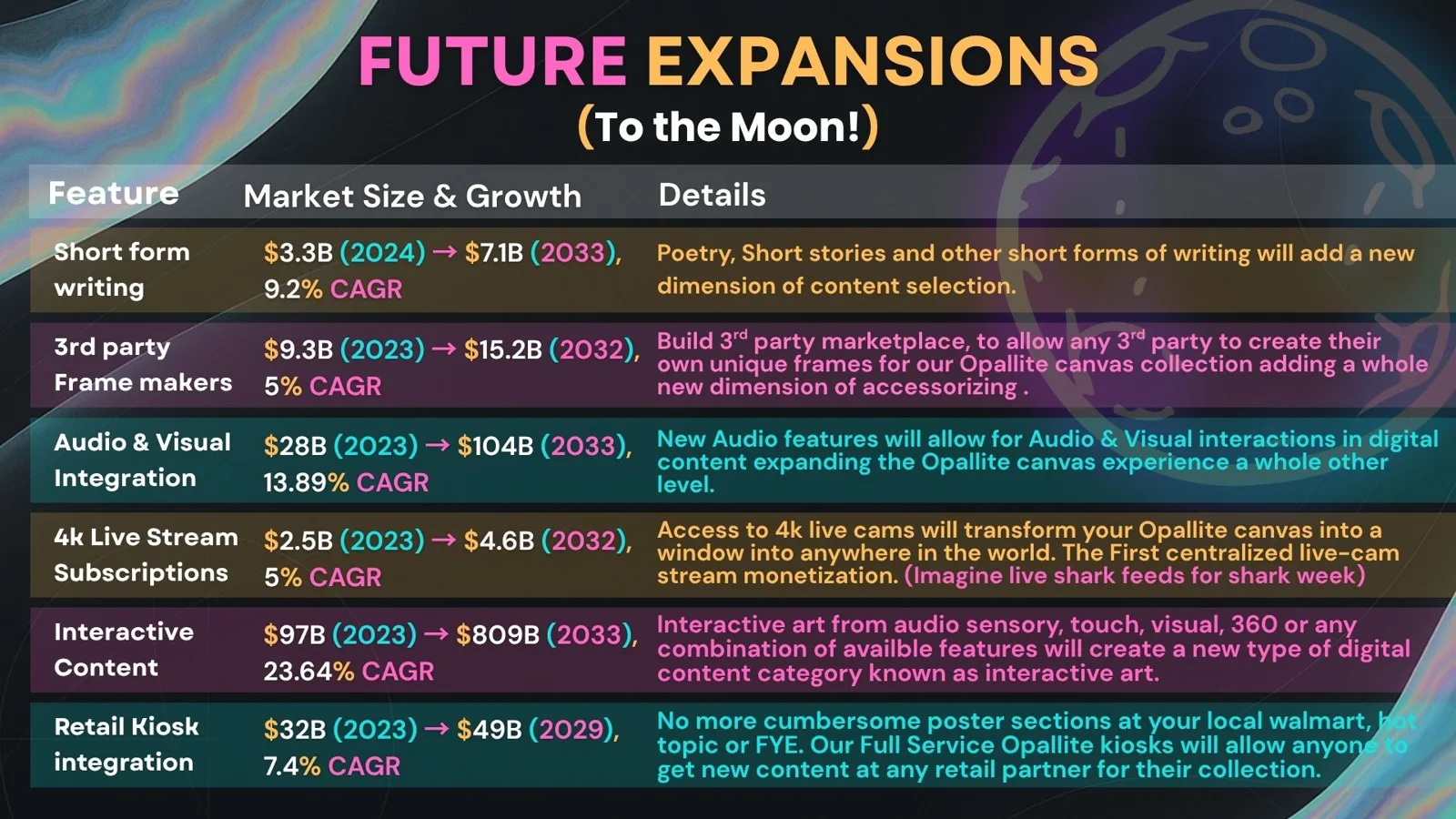
Each canvas would carry two expansion ports in a USB-C form factor, up to 15 watts and up to 10 Gbps. A speaker, a sensor, a controller or a memory module could plug in, the way accessories plug into a phone or a console. The deck points at this direction on slide 12: "3rd party Frame makers", a marketplace that lets any third party "create their own unique frames", and a line on audio and visual integration.
Why a platform, not a product
Chapter 11 opens with an argument I still like:
"Each new accessory increases the value of the Digital Canvas to consumers, while each new consumer increases the market for accessory makers."
If outside makers build frames and add-ons, the canvas gets more useful without me building all of it. It also gets harder to copy, because the accessories only fit one system. The chapter says a thriving accessory ecosystem "creates significant barriers to entry for potential competitors."
My market-adoption write-up has the same instinct. A modular design keeps the entry price low, while "anyone who wishes to spend more money for the nicer frames & features can do so." The frames I sketched there were a designer-brand frame, a sports-network frame and a limited-edition frame sold at theaters. They are illustrations of what a third party might make. No brand has agreed to anything.
Open standard, closed certification
An open standard invites builders and bad accessories. The plan answers the way existing accessory programs do. It names Apple's MFi program, the Philips Hue developer program and console accessory licensing as models. The shape:
- The latch and port specifications are published, so anyone can build to them.
- A certification mark, "MagFrame Ready" in the draft, tells buyers an accessory passed a check.
- Certified makers pay a one-time certification fee and a license, and a revenue split applies when the accessory sells through the platform.
The draft's numbers are design choices, not market evidence: certification of $2,500 to $10,000, trademark licenses of $1,000 to $5,000 a year, developer memberships of $99 to $2,999 a year, and platform splits of 70/30 for physical products and 80/20 for software. Talking to people who make accessories could change every one.
The chapter also quotes figures about those existing programs, such as the count of certified Apple accessories. I could not confirm the cited reports, so I am not repeating them. The plan says "core patents", but no filing is named anywhere in my files, so I claim nothing is patented.
Where the plan disagrees with itself
Chapter 11 sizes the frame market at $1.2 billion by 2030 and assumes Opallite captures 15 to 25 percent of it. That is $180 to $300 million, more than the chapter's own Year 5 frame forecast of $150 to $200 million. Read against itself, the plan has a hole there. A number in a chapter is only as good as the check I give it.
Where this stands
Opallite is at concept stage, Technology Readiness Level 1-3 in the deck. There is no latch, no port and no third-party maker. What Chapter 11 gives me is a design question I can test first: does a frame snap on and hold firmly, and can a stranger build one from a spec sheet?

A standard is only real when a stranger can build to it from a spec sheet. That is the whole idea.
