Opallite's plan has a rule that surprises people: the marketplace sets a minimum price for digital art. Here is the reasoning behind it, and which of its numbers are mine rather than evidence.
The rule
The plan says it in one line: "This is not a thrift store; it's a gallery supporting artists and educating collectors on the deserved value of digital art."
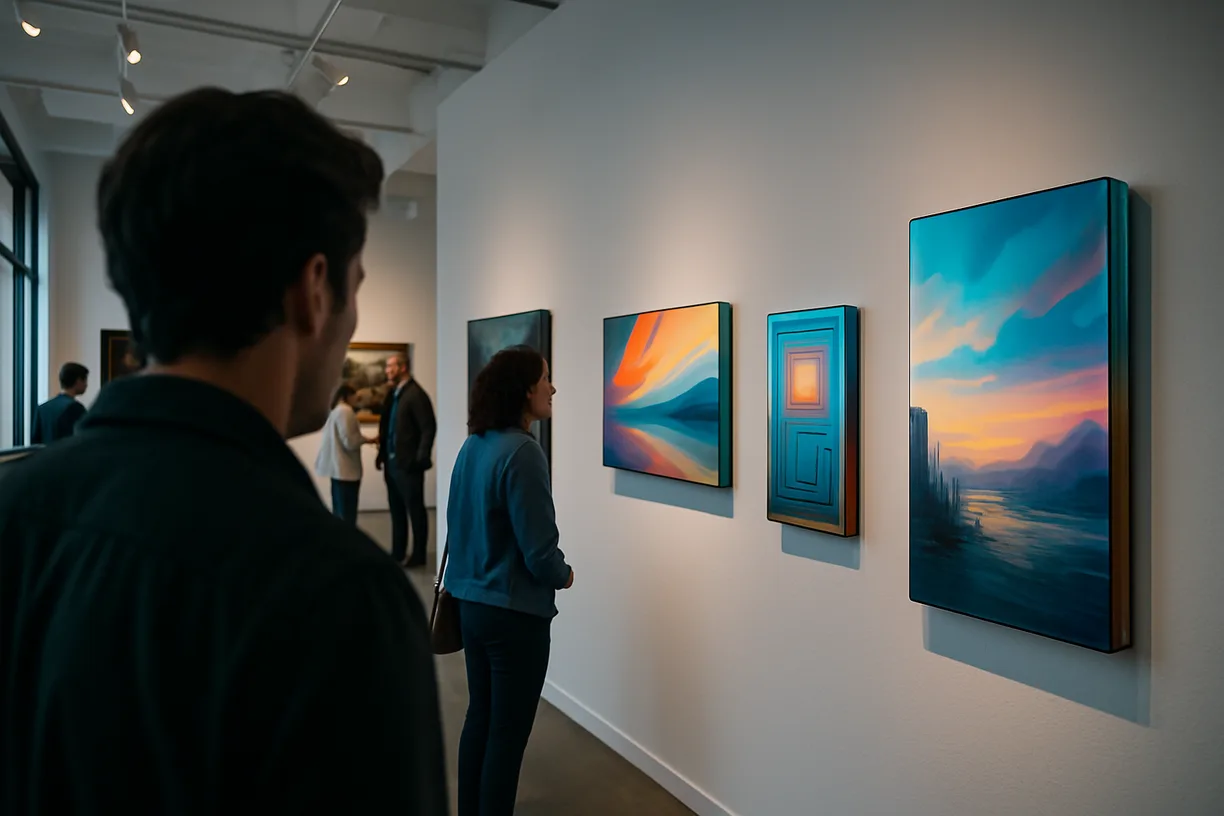
The race to the bottom
Digital art is easy to copy and easy to give away. In an open market one artist undercuts another, then another undercuts them, and the price drifts toward zero. The plan calls it a "race to the bottom." The first post in this series was about digital art having no presence and no value, and a floor is one way to give it value on the platform.
The plan's rationale is that minimum prices signal quality, reflect artist effort and set a sustainable sense of value. My own version is shorter. A price tells the buyer how to look at the work, and a floor means no artist has to match the cheapest seller.
The floors I proposed
These are design choices, not market data. They scale with how established the artist is and how limited the edition is.
- Original digital artworks: $75 for emerging artists, $150 for mid-career, $300 for established
- Limited editions, per piece: $95 for editions of 1 to 10, $65 for 11 to 50, $35 for 51 to 250
- Commissions: $150 basic, $300 standard, $600 complex
- Fan art: $50 original, $30 limited, $20 open
Edition floors fall as the edition grows, because the more copies exist, the less scarcity each one carries. The plan also phases the rule in: recommended for the first three months, enforced from month four, with promotions allowed up to 30% below the floor.
The projection, and its three assumptions
The plan projects that floors lift the average sale from $45 to $85, about 89% more. If volume falls about 12%, from 2.5 million sales to 2.2 million, commission revenue at 20% rises from $22.5 million to $37.4 million, about 66% more. The arithmetic holds.
But the arithmetic is not the claim. The claim rests on three numbers I chose: the $45 starting average, the $85 after, and the 12% drop. I have no marketplace data because there is no marketplace. Everything hinges on whether buyers accept the floors without leaving in larger numbers than I assumed, and only a real launch can answer that.
The tension with access
A floor pulls against another goal of mine, making digital art accessible. A $35 floor on a large edition is low, but a $75 floor on an original will turn some people away. The plan answers by getting access from elsewhere: free basic tiers for artists and collectors (slide 6) and an affordable entry-level canvas. The floors protect the art, and the rest of the model has to keep the door open.
Who gets what
For direct sales, slide 6 gives 80% to the artist and 20% to Opallite. For curated sales through a venue, it gives 50% to the artist, 30% to the venue and 20% to Opallite. That 20% is the commission in the projection above.
What I would test first
A small pilot: a handful of artists, different floors, and a look at where buyers stop. Then the plan's figures would become real ones, or I would learn they were wrong. Until then the floors are a principle with numbers attached for discussion, and the principle is simple: digital art should be treated as art.
