Every claim,traced to its
source.
The Journalism Workbench is a private, local-first investigation desk for reporters and citizen investigators. Bring in documents, check every claim against its source, see who is linked to whom and where the money went, and act only on what holds up. The AI is optional and bounded: it can propose, never decide.
- My role
- Founder, product lead and designer; I direct the engineering
- Status
- In active private development, 2026
- Built with
- Python and FastAPI, PostgreSQL, Next.js, OpenAleph, local models
- Scale
- 16 approved screens · 14 recorded decisions · ~300 test files
A pile of records, a hunch,and no research desk.
An independent reporter gets documents as PDFs, scans, emails and spreadsheets. The same names repeat across hundreds of pages, spelled three ways. There's no research desk, no lawyer on call, and one overstated sentence can sink a story and hurt someone who did nothing wrong.
AI makes it faster to be wrong. A database match, a scanned page or a model's guess all look like facts. In the Workbench, every one of them enters as a lead or a proposal, never as a fact.
When the app says Supported, I can publish that sentence and defend it to a lawyer.
The job the app has to do, from the design research
A human gate beatsa smarter model.
It can propose.It can never decide.
- 01
Packet
The model sees only a packet of records a person has already reviewed. Nothing else.
- 02
Method
Its instructions are the Authority System Suite's own modules, with the run settings shown in plain words first.
- 03
Guard
Instruction-like text hidden in the evidence (“ignore previous instructions”) is caught and shown before the run.
- 04
Gates
Every answer must pass the schema, every citation must be in the packet, and every quote is checked word for word.
- 05
Proposal
What survives lands in a review queue as a proposal. Nothing joins the case until a person accepts it.
The AI never types a number
Charts are ordered from a fixed catalogue of queries and their values computed from the records. A model can ask for a chart; it can't write the figures in it.
Private by default
Models run on the reporter's own computer. Remote services are refused unless explicitly allowed, fonts are bundled so nothing calls out while a sensitive case is open, and every outbound request is logged word for word.
How this factgot here.
Cinematic where it helps,calm where it matters.
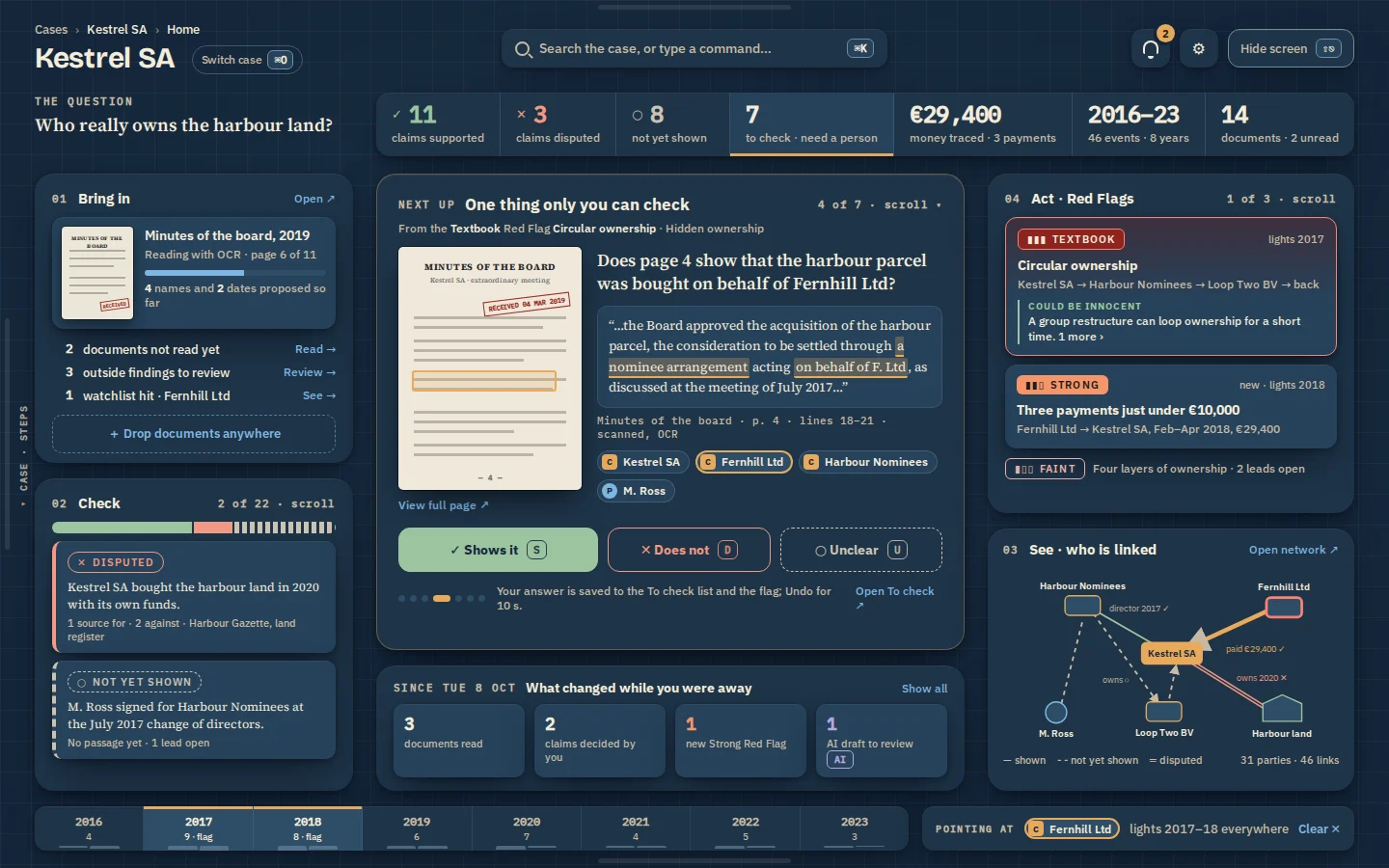
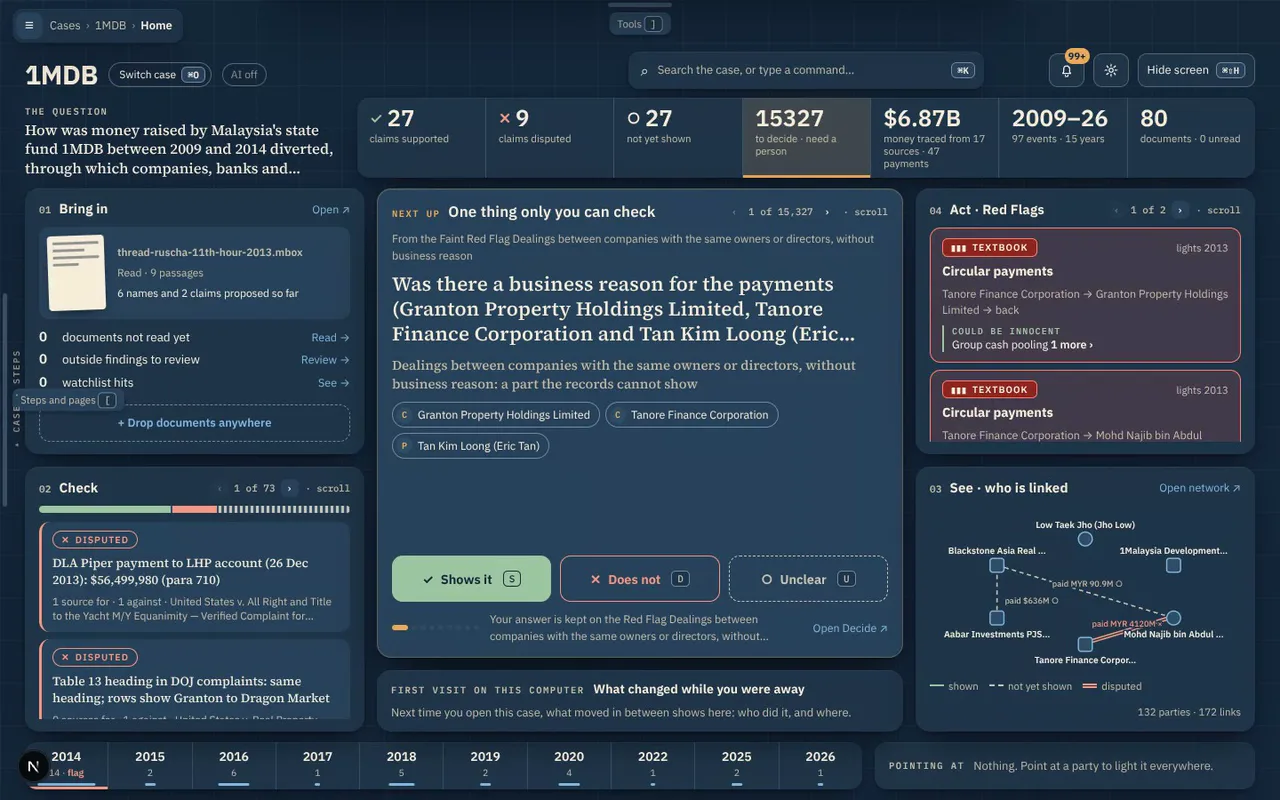 Approved mockupRunning app
The first version worked and was hard to use. So I stopped and redesigned every part from research: a 252-page study, 16 screens approved as mockups before any code changed, and a build list that checks every screen against its picture.
Five themes share one status grammar: ✓ supported, ✕ disputed, a dashed ring for not yet shown, dotted for anything the app worked out itself. Every theme is contrast-checked, and a theme maker refuses to save a pair that fails.
Rain Noir, a city at night through a wet window, is built from the light engine I wrote for this site. Effects never sit over text, and they switch off in the reading room, tables and the chain of custody.
Directing the work,decision by decision.
The engine: provenance on every fact, sanctions and outside-database lookups, a relationship graph, and previews that run with no AI at all.
My own rigor method becomes the AI layer: the suite's modules, vocabularies and settings, with tests that fail if the two drift apart.
Decision: stop rebuilding document reading and search, and build on OpenAleph, the open-source tool newsrooms already use.
2,946 published red-flag indicators in 42 areas, kept as reviewable data with one source for the engine, the glossary and the printed guide.
Turning point: “This entire site needs redesigned. It is not user friendly at all.” A 252-page redesign study follows.
16 screens approved as mockups. The build list tracks every screen against its picture, item by item.
Watch the run, the theme maker, the indicator catalogue, and “reading never writes”: opening a page can no longer change the case.
A tradeoff
Building our own document reading, OCR and search would have kept everything in one codebase. Building on OpenAleph meant giving up that control, and in return the app stopped doing the same job twice and inherited a tool newsrooms already trust. Reading its source showed one of its features had never been switched on.
How I run it
The engineering is done by AI agents working under written doctrine: recorded decisions, an audit-and-fix loop, mockups approved before code, and a rule that a problem in the method is reported to the method, not patched in the app.
What isn't on this page
The app is private. The mockup screens here are design mockups on a fictional teaching case; the recordings are the running app on a demo case built from public records. No private investigation appears, and security details stay out too. I'm happy to demo it live.
Ask for a demo →More case studies
All work and career →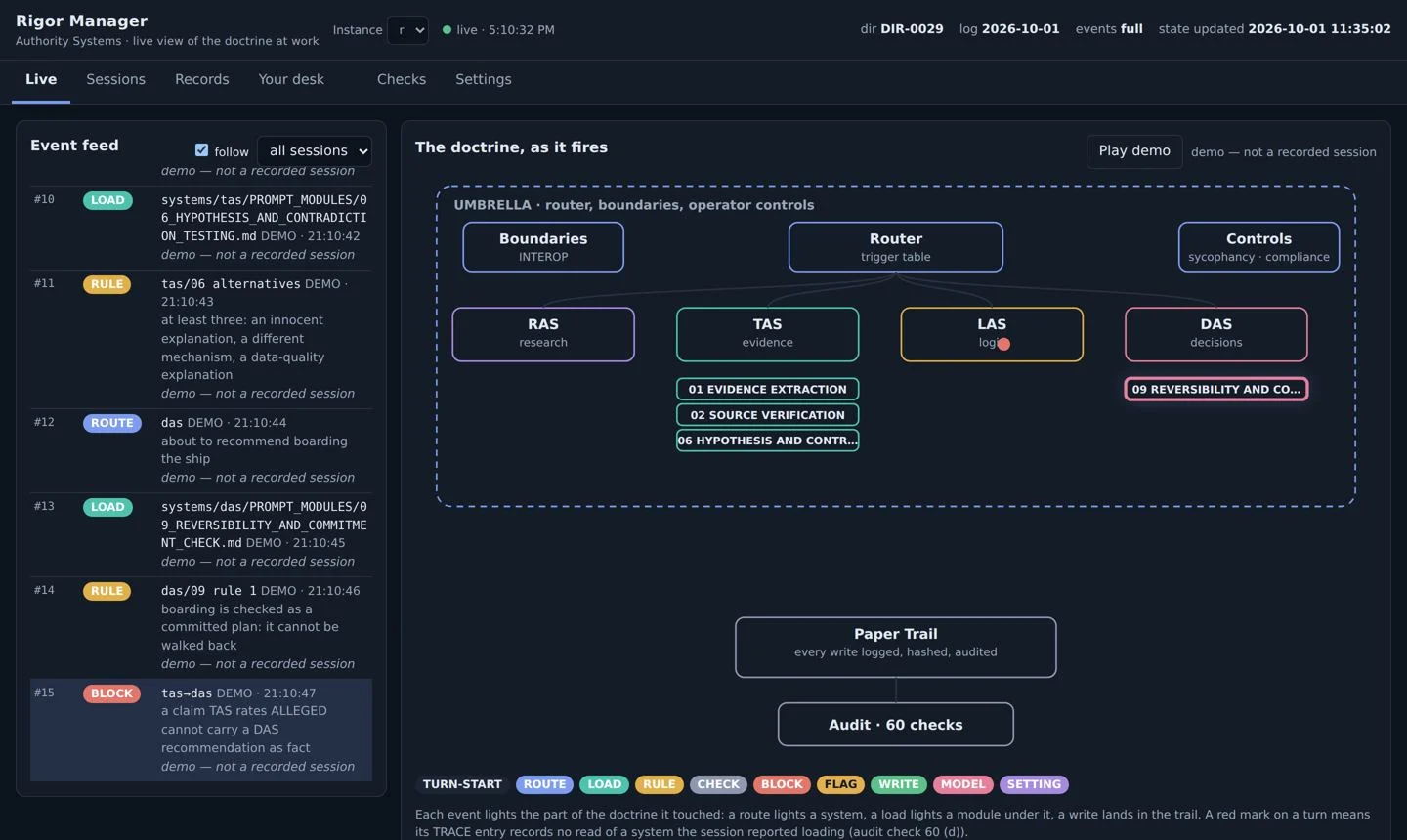


Get in touch.
I'm open to creative technical project management, founding teams, and agentic AI engineering and research. I read everything that comes in, and I answer.
onysnowstudios@gmail.comLinkedIn →
